

In the seventh week of a newborn’s life, parents usually notice more noticeable changes in their baby’s behavior and level of alertness. A 7-week-old infant tends to stay awake longer than in previous weeks, responds more clearly to sounds, and may begin to show the first signs of a social smile and more consistent eye contact. At this age, common questions also arise: How should a seven-week-old baby sleep? How often should they be fed? Why does the baby seem more irritable on some days?
In this article, we review the most important aspects of growth and development in a seven-week-old infant in a simple yet practical way—from sleep and feeding to appropriate play, taking the baby outdoors, and warning signs that indicate when it is better to consult a physician.
A 7-Week-Old Baby: What Changes Occur at This Stage?

During the seventh week, the infant gradually moves beyond the completely dependent newborn stage and shows greater awareness of their surroundings. A seven-week-old baby usually has longer periods of wakefulness and appears more curious, observing the environment more attentively.
Common changes at this stage include:
- Increased attention to faces, especially those of parents
- More stable and sustained eye contact compared to previous weeks
- Responding to familiar voices and sounds
- Becoming calmer when held or when hearing a parent’s voice
- More purposeful movements of the arms and legs
At this age, the baby is still very young, but brain development is occurring at a rapid pace. Some days the baby may appear calm, while on other days more irritable—both patterns are considered normal during the seventh week of life.
It is important to remember that infants do not all develop at the same pace. If your baby does not show all of these signs simultaneously, it is not necessarily a cause for concern.
Physical Development of a Baby in the Seventh Week
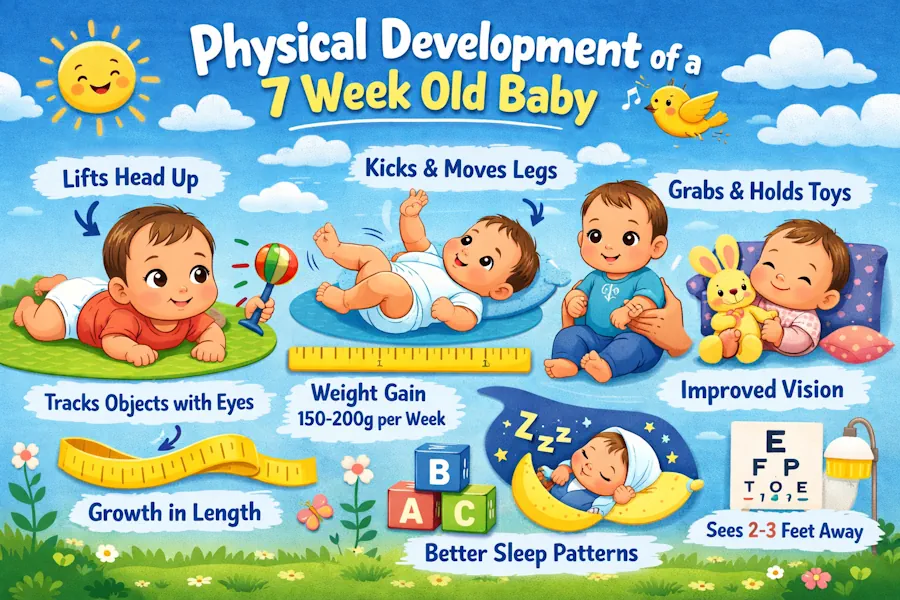
In the seventh week, physical growth continues at an appropriate rate, although it may appear more gradual compared to the early weeks after birth. A 7-week-old infant gradually becomes stronger and gains better control over body movements.
Key indicators of physical development at this age include:
Weight and Length Gain
Most infants have achieved appropriate weight gain by this time. If the baby feeds regularly and produces wet diapers consistently, weight gain is generally considered normal.
Improved Head and Neck Control
Although the neck is not yet fully strong, when held upright or placed on the stomach, the baby may be able to lift their head for a few seconds.
More Coordinated Arm and Leg Movements
Kicking and arm movements become more coordinated than before. Some babies at this age bring their hands to their mouth.
Changes in Body Shape
The newborn fat distribution may begin to even out, and the limbs may appear slightly longer and more defined.
To support physical development during the seventh week:
- Provide short sessions of tummy time several times a day
- Gently hold and reposition the baby
- Allow the baby to move their arms and legs freely
If your baby still has very poor head control or their growth seems slower than expected, it is advisable to discuss this during routine pediatric checkups.
How Is Sleep in a 7-Week-Old Baby?
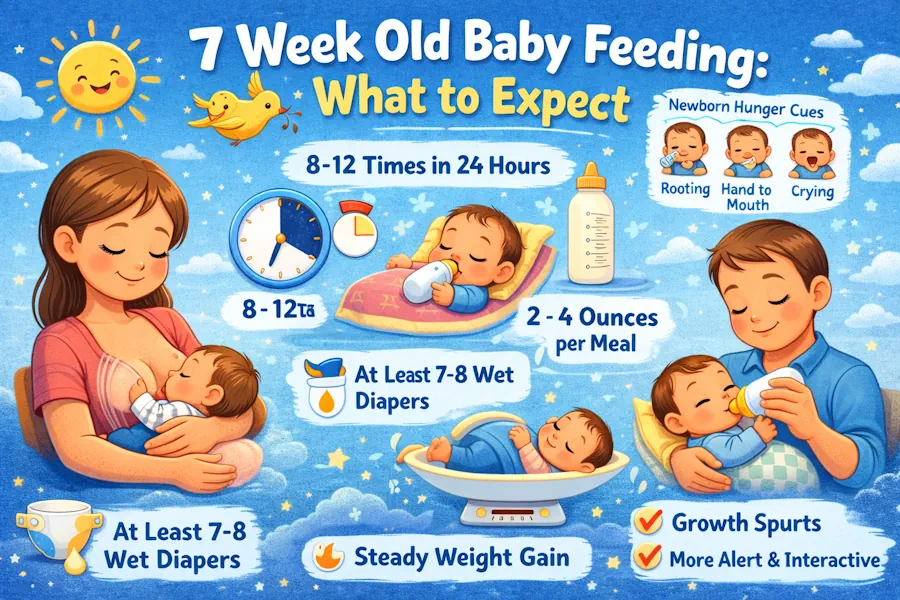
Sleep is one of the main concerns for parents during the seventh week. A 7-week-old baby does not yet have an adult-like sleep pattern, but positive changes compared to the early newborn period are often noticeable.
Sleep Pattern of a Seven-Week-Old Infant
At this age, infants typically:
- Sleep 14 to 17 hours over a 24-hour period
- Sleep in multiple segments throughout the day and night
- Some babies may sleep 3 to 4 consecutive hours at night
Waking during the night for feeding is completely normal and not a negative sign.
Why Is Sleep Still Irregular at This Age?
The main reasons include:
- Rapid brain and nervous system development
- Ongoing need for frequent feeding
- Inability to distinguish day from night
Gradually, with exposure to daylight and nighttime darkness, the baby’s sleep rhythm begins to form.
Signs of Sleepiness in a Seven-Week-Old Baby
Recognizing these signs helps parents put the baby to sleep at the right time:
- Rubbing the eyes
- Yawning
- Mild fussiness
- Staring or reduced responsiveness
If the baby becomes overtired, settling them to sleep may become more difficult.
How to Help Improve Sleep in the Seventh Week
To support better sleep:
- Create a clear difference between day and night (light and sound levels)
- Establish a simple bedtime routine, such as a bath or lullaby
- Keep the sleep environment calm and dim
- Place the baby in bed when drowsy but still awake
Remember that each baby has their own unique sleep pattern, and comparisons with other infants are unnecessary.
Feeding a Baby in the Seventh Week
During the seventh week, feeding remains the most important factor for growth and comfort. A 7-week-old infant receives all necessary nutrients from breast milk or formula and does not require any complementary foods.
Feeding Frequency of a Seven-Week-Old Baby
Typically:
- The baby feeds every 2 to 3 hours
- Some infants experience periods of cluster feeding
- Nighttime feeding intervals may become slightly longer
This pattern is normal and reflects the baby’s growth needs.
Breast Milk or Formula?
- Breast milk is the best option and supports immune system development
- If formula is used, the type and amount should follow medical advice
The most important factor is adequate intake, regardless of feeding method.
Signs of Adequate Feeding in a 7-Week-Old Infant
Adequate feeding is likely if the baby:
- Produces wet diapers regularly
- Appears calm after feeding
- Gains weight appropriately
Cluster Feeding in the Seventh Week
Some babies at this age:
- Want to feed repeatedly over short periods
- Are more irritable in the evening or at night
This behavior is normal and often associated with growth spurts.
Burping a Seven-Week-Old Baby
At this age:
- Burping after each feeding is helpful
- Holding the baby upright for a few minutes is usually sufficient
Burping helps reduce gas and discomfort.
When Should You See a Doctor?
If the baby:
- Does not feed well
- Is not gaining weight adequately
- Has severe vomiting after feedings
Medical consultation is recommended.
Crying and Fussiness in a 7-Week-Old Baby
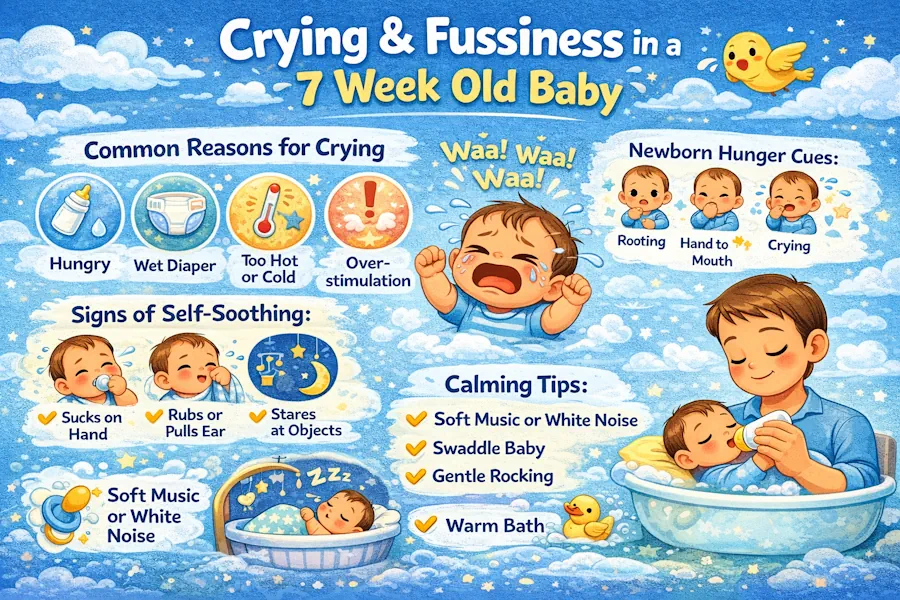
Crying is the primary form of communication for a 7-week-old infant. During the seventh week, parents may notice increased fussiness at certain times of the day, particularly in the late afternoon or early evening. In most cases, this is normal and part of typical development.
Why Does a Seven-Week-Old Baby Cry?
Common causes include:
- Hunger
- Sleepiness
- Gas or the need to burp
- Desire for physical contact
- Overstimulation (noise, light, crowded environments)
Sometimes babies cry without a clear identifiable cause.
Peak Crying Around the Seventh Week
Many infants between 6 and 8 weeks of age:
- Experience a temporary increase in crying
- Become more fussy at specific times of the day
This phase is usually temporary and gradually resolves.
How to Soothe a 7-Week-Old Baby
Helpful strategies include:
- Holding or swaddling the baby
- Speaking softly or singing
- Gentle rocking
- Feeding or burping
- Creating a calm, low-stimulus environment
Each baby responds differently; some trial and error is normal.
When Is Crying Concerning?
Consult a physician if crying is:
- Very intense and prolonged
- Accompanied by fever, vomiting, or lethargy
- Suddenly different from the usual pattern
Crying does not indicate poor parenting—it is a normal part of infant development.
Smiling and Social Responses in a Seven-Week-Old Baby
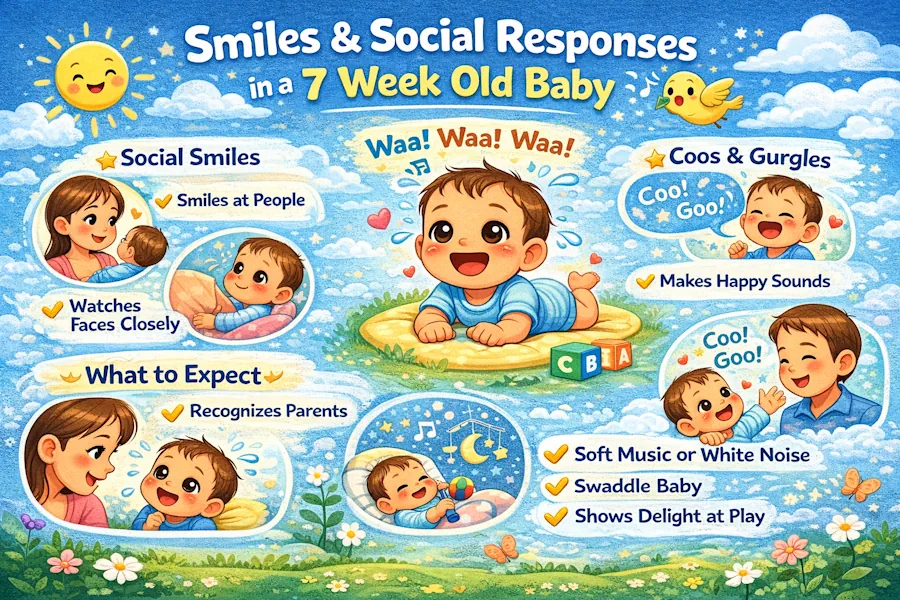
One of the most enjoyable milestones of the seventh week is the appearance of a purposeful social smile. Unlike the reflexive smiles of earlier weeks, a 7-week-old baby may smile in response to faces, voices, or attention.
What Does Smiling Mean at This Age?
Smiling indicates:
- Brain and nervous system development
- Recognition of familiar faces
- The beginning of social interaction
These smiles are often brief but genuine.
Social Responses in a 7-Week-Old Infant
You may observe:
- Longer eye contact
- Calming in response to parental voices
- Tracking faces with the eyes
- Simple vocal sounds such as “ah” or “oo”
These behaviors reflect emotional and cognitive development.
How to Encourage Social Interaction
To enhance interaction:
- Make eye contact during alert periods
- Talk to the baby and respond to their sounds
- Smile and vary facial expressions
- Hold the baby at an appropriate distance from your face
Just a few minutes of calm interaction at a time is highly beneficial.
What If the Baby Is Not Smiling Yet?
Lack of smiling at this stage is not necessarily concerning. Some babies:
- Smile a bit later
- Show other social signs first, such as eye contact
If no social responses are observed by the end of the third month, medical evaluation is advised.
Play and Interaction With a 7-Week-Old Baby
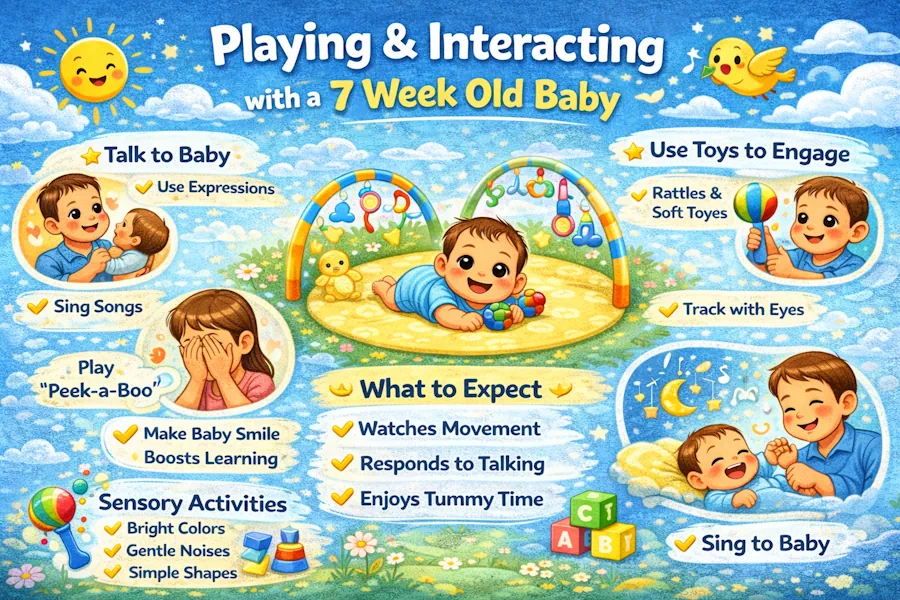
At the seventh week, play does not involve complex toys. A 7-week-old infant learns through seeing, hearing, and touch, and simple interactions play a crucial role in brain and emotional development.
Appropriate Activities for a Seven-Week-Old Baby
Best activities include:
- Talking and singing softly
- Smiling and changing facial expressions
- Showing high-contrast toys
- Gentle touching of hands and feet
- Short tummy-time sessions
A few minutes per session is sufficient.
Tummy Time in the Seventh Week
Tummy time:
- Strengthens neck and upper body muscles
- Prepares the baby for rolling and sitting
At this age:
- Several times per day
- 1 to 3 minutes each time
- On a safe, soft surface
Stop if the baby becomes uncomfortable.
Signs of Fatigue During Play
If the baby:
- Turns their head away
- Becomes fussy
- Cries
They likely need rest. Too much stimulation can be overwhelming.
Is Constant Entertainment Necessary?
No. At this age:
- Independent observation of the environment is also beneficial
- Babies can be entertained by light, sounds, and simple movements
A balance between interaction and rest is ideal.
Taking a Seven-Week-Old Baby Outdoors

Taking a seven-week-old baby outside, when done safely, can be a pleasant and beneficial experience. Exposure to new environments supports sensory stimulation and better sleep regulation.
Is It Safe to Take a 7-Week-Old Baby Outside?
Yes, provided that:
- The environment is not overly crowded
- Contact with sick individuals is limited
- Outdoor time is brief and controlled
Fresh air often improves the baby’s comfort.
Best Times to Go Outside
Recommended times:
- Early morning
- Late afternoon
During these periods:
- Sun exposure is milder
- Temperatures are more comfortable
Appropriate Clothing for Outdoor Activities
A simple rule:
- Dress the baby in one more layer than you are wearing
Additional tips:
- Choose lightweight, breathable fabrics
- Use a light hat in cool weather
- Avoid overdressing
Sun Protection
Infant skin is very sensitive:
- Avoid direct sun exposure
- Shade is the best protection
- A stroller with a canopy is ideal
Sunscreen use at this age should only be done under medical guidance.
Stroller or Carrier?
Both are suitable:
- Strollers for short walks
- Baby carriers for added comfort
Always ensure proper head and neck support.
If the baby becomes fussy outdoors, return home or change environments.
Safety Care for a 7-Week-Old Baby
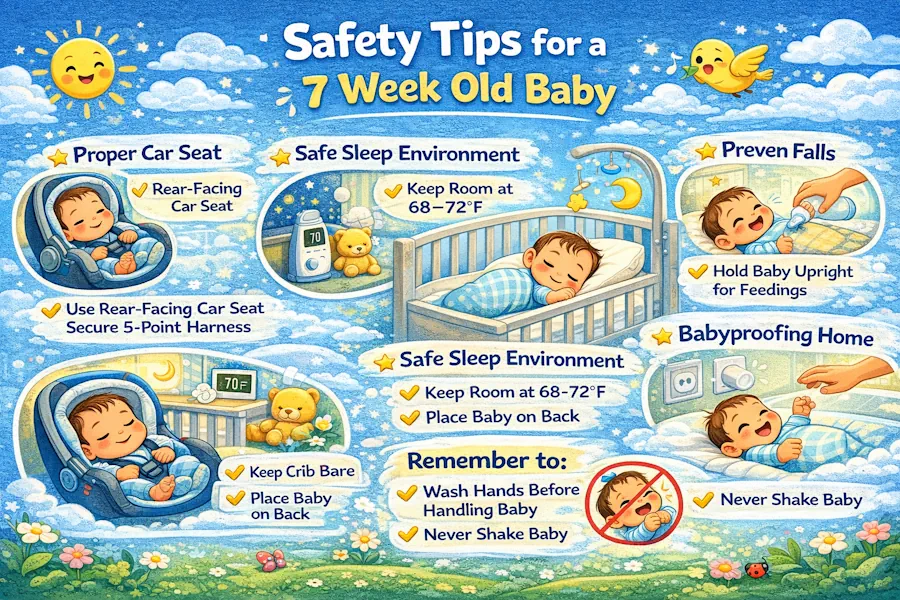
Although a 7-week-old infant has limited mobility, safety precautions are essential. The baby is entirely dependent on caregivers, and the environment should be adapted accordingly.
Sleep Safety
To reduce risk:
- Always place the baby on their back
- Use a firm, flat sleep surface
- Avoid pillows, thick blankets, and toys in the crib
- Maintain a comfortable room temperature
Safe sleep practices are critical at this age.
Safe Handling and Positioning
- Always support the baby’s head and neck
- Never leave the baby unattended on elevated surfaces
- Keep one hand on the baby during diaper changes
Even small movements can result in falls.
Outdoor Safety
- Avoid direct sunlight
- Limit exposure to sick individuals
- Ensure proper use of stroller and car seat restraints
Bathing and Diaper Safety
- Never leave the baby alone in the bath
- Check water temperature before use
- Prepare all supplies in advance
Preventing Overstimulation
At this stage:
- Bright lights, loud noises, and crowded environments may cause distress
- A calm environment promotes better sleep and comfort
These simple precautions help create a safe and nurturing environment for a seven-week-old baby.
When Should You Take a 7-Week-Old Baby to the Doctor?
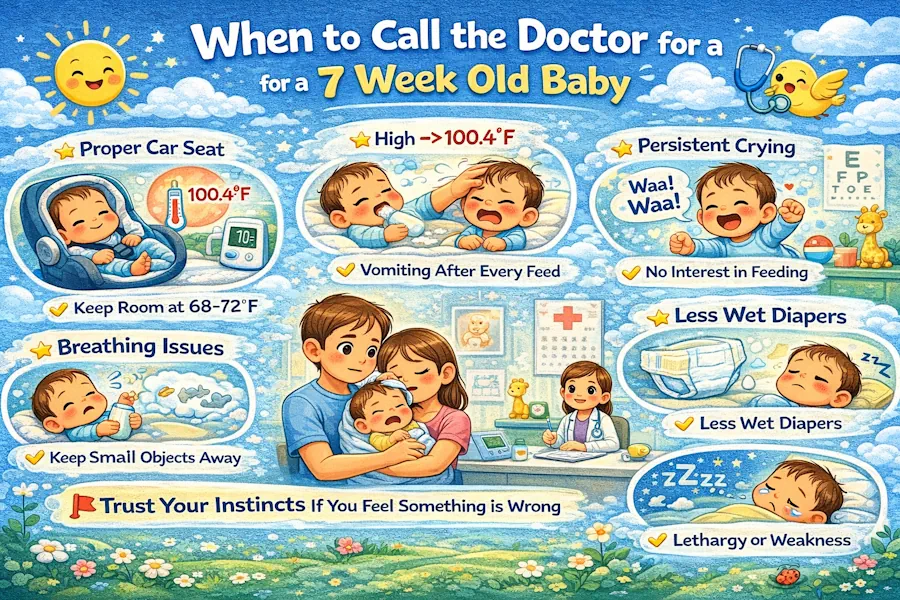
Most behaviors in a 7-week-old infant are normal, but certain signs warrant medical evaluation.
Warning Signs
Seek medical care if the baby shows:
- Fever (temperature above 38°C / 100.4°F)
- Reduced or stopped feeding
- Decreased number of wet diapers
- Severe or repeated vomiting
- Severe diarrhea or constipation
- Unusual lethargy or excessive sleepiness
- Inconsolable crying
- Changes in skin color (marked jaundice, pallor, or bluish discoloration)
Developmental Concerns
Consult a doctor if the baby:
- Does not make eye contact
- Does not respond to sounds
- Shows no social smile by the end of the second month
Trusting Parental Instincts
If you feel that:
- The baby’s behavior is different from usual
- Something simply does not seem right
Consulting a physician is always appropriate.
Parents are the best observers of their baby’s health, and when in doubt, seeking medical advice is the safest choice.
Frequently Asked Questions About a 7-Week-Old Baby
How many hours does a 7-week-old baby sleep per day?
A seven-week-old infant typically sleeps 14 to 17 hours per day in multiple segments. Nighttime waking for feeding is normal.
Is frequent crying normal at 7 weeks?
Yes. Many babies experience increased crying between 6 and 8 weeks, especially in the evening. This phase is usually temporary.
How often should a seven-week-old baby feed?
Most babies feed every 2 to 3 hours. Periods of cluster feeding are normal.
Is a baby’s smile at seven weeks real?
Yes. Smiles at this age are usually social smiles in response to interaction.
Is it normal if a 7-week-old baby is not smiling yet?
Yes. Some babies smile later. If no social response is seen by three months, consult a physician.
Is it harmful to take a seven-week-old baby outside?
No, when done safely and avoiding direct sunlight and crowded environments.
Does a 7-week-old baby need playtime?
Yes, but play should be simple and brief, such as talking, singing, and short tummy-time sessions.
When should a 7-week-old baby see a doctor?
If symptoms such as fever, poor feeding, reduced wet diapers, severe crying, lethargy, or repeated vomiting occur.
Summary of the Seventh Week
The seventh week of life is an important stage of growth and development. A 7-week-old baby becomes more alert, begins showing social responses such as smiling, and gradually develops more predictable sleep-wake patterns. Crying and fussiness remain normal aspects of neurological development.
Feeding continues exclusively through breast milk or formula, while simple play and interaction support both physical and emotional growth. Safe outdoor exposure, proper sleep and handling practices, and attention to warning signs are essential aspects of care during this period.
Each baby develops at their own pace. Avoid unnecessary comparisons, trust your observations, and combine parental intuition with professional medical guidance to support healthy development in a seven-week-old infant.






No comment