
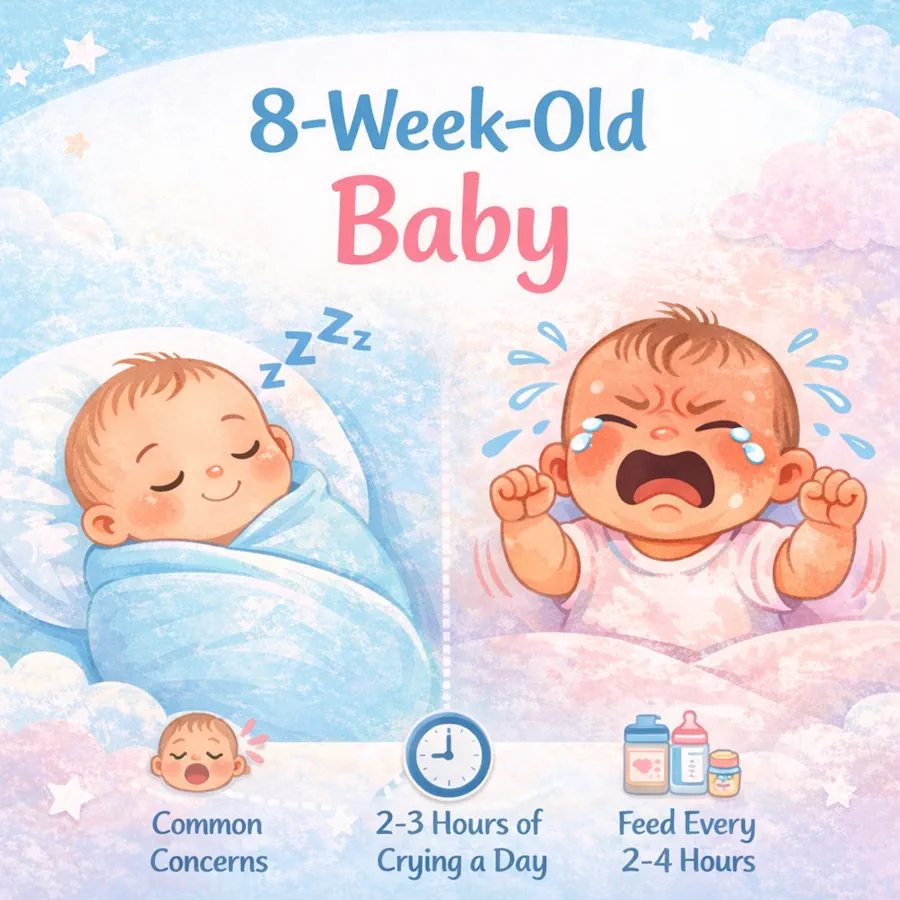
An 8-week-old baby is at a stage where many developmental changes become noticeable to parents. At this age, the baby moves beyond the very early newborn period and enters a phase in which brain development, the nervous system, and muscle control continue to progress more rapidly. As a result, behaviors, sleep patterns, types of crying, and even reactions to sounds and faces appear different compared to the first weeks of life.
Many parents wonder exactly how old an 8-week-old baby is in months and what abilities they should expect at this stage. An eight-week-old baby is approximately at the beginning of the second month of life and is still adapting to the world outside the womb. Despite individual differences among babies, most infants at this age show signs of increased alertness, attempts to control body movements, and more intentional responses to their surroundings.
Understanding the developmental characteristics of an 8-week-old baby helps parents distinguish normal behaviors of this stage from unusual signs and follow their child’s growth with greater peace of mind. In this article, the physical and neurological development, sleep, feeding, and common behaviors of an eight-week-old baby are examined in a precise and scientific manner.
What Does 8 Weeks Old Mean in Months?
From an age perspective, an 8-week-old baby is at the beginning of the second month of life. Each month consists of approximately four weeks, so when eight weeks have passed since birth, the baby is about two months old. However, in medical and developmental assessments, infants’ ages are usually calculated by weeks rather than months, because growth changes occur very rapidly during this period.
At eight weeks, the baby is still in the process of adapting to life outside the womb, and many of their characteristics differ from those of a three-month-old infant. For this reason, pediatricians and child development specialists typically use the term “8-week-old baby” rather than simply “two months old.” This distinction helps parents develop more realistic expectations about their baby’s abilities, sleep, and behavior.
In summary, if your baby is 8 weeks old, they can be considered approximately two months old, but they are still in one of the most sensitive and fastest-growing stages of early life.
How Does an 8-Week-Old Baby Develop?

At eight weeks of age, a baby’s development enters a stage where changes become more noticeable than before. At this age, development is not limited to increases in height and weight; the brain, nervous system, and muscle coordination are also developing rapidly. As a result, the baby’s behaviors and reactions appear more purposeful compared to the early weeks of life.
In terms of physical development, an 8-week-old baby has usually gained a noticeable amount of weight since birth, and muscle tissue is gradually becoming stronger. The muscles of the neck and upper body begin to activate more, and when placed on their stomach, the baby may attempt to lift their head for a few seconds. This ability is a sign of normal development of the neck and spinal muscles, and full head control is not yet expected.
Neurological development plays a key role at this stage. The baby’s brain is continuously forming new connections between nerve cells. This process makes the baby’s reactions to sounds, light, and faces more distinct. Many babies at eight weeks respond to familiar sounds, maintain brief eye contact, and even show smiles that appear more intentional than those seen in earlier weeks.
Movements of the arms and legs are still not fully coordinated, but they are no longer purely random. The baby may bring their hands toward their face, open and close their fingers, or briefly grasp nearby objects. These movements indicate the early stages of coordination between the brain and muscles, which will continue to develop in the coming months.
Overall, the development of an 8-week-old baby is a combination of gradual increases in physical strength, rapid neurological growth, and the beginning of more intentional interaction with the surrounding environment. Differences in the pace of development at this age are normal, and growth should be evaluated based on overall progress and medical guidance rather than exact comparisons with other babies.
Abilities of an 8-Week-Old Baby

An 8-week-old baby is still at the very beginning of their developmental journey, but at this age a set of early abilities begins to emerge that is more noticeable than in the first weeks of life. These abilities result from the gradual development of the brain, nervous system, and muscles, and they do not appear at the same pace in all babies.
One of the most important abilities at eight weeks is increased awareness of the surrounding environment. The baby can briefly focus on parents’ faces and react to familiar sounds. These reactions may appear as calming down, moving the arms, or changes in facial expression, and they indicate the beginning of intentional interaction with the environment.
From a motor perspective, an 8-week-old baby has limited control over the head and neck. When placed on their stomach or held upright, the baby may be able to lift their head for a few seconds, but full support is still required. Arm and leg movements are more active, and the baby may occasionally bring their hands toward their face or open and close their fingers.
The ability to grasp objects at this age is mostly reflexive. The baby may grasp your finger or a piece of clothing, but they are not yet able to intentionally release or purposefully grab objects. These skills gradually develop in the following months.
In terms of communication, some 8-week-old babies begin to produce short sounds that are not cries. These sounds represent early attempts at communication and indicate that the baby is learning to use their voice to respond to the environment. Smiles seen at this age are often more intentional than the reflexive smiles of the first weeks.
Overall, the abilities of an 8-week-old baby are still basic and unstable, but they reflect a normal developmental process. What matters most is gradual progress and the baby’s responsiveness to their environment, not achieving a specific skill at an exact time.
Sleep of an 8-Week-Old Baby

The sleep of an 8-week-old baby does not yet follow a consistent pattern, and from a scientific perspective, regular nighttime sleep is not expected at this age. At two months old, the baby’s brain is still unable to fully distinguish between day and night, and sleep cycles remain short and fragmented. Therefore, frequent nighttime awakenings are completely normal.
On average, an 8-week-old baby sleeps about 14 to 17 hours over a 24-hour period. This sleep occurs in short, scattered intervals and may include several naps during the day and multiple awakenings at night. Some babies at this age may sleep for 3 to 4 consecutive hours, but this is not a general rule, and the absence of longer stretches is not a sign of a problem.
At eight weeks, a significant portion of the baby’s sleep occurs in the active or light sleep stage. During this time, the baby may move, make sounds, or even keep their eyes partially open. These behaviors are a normal part of brain development and do not indicate that the baby is awake or that their sleep quality is poor.
Nighttime awakenings often occur due to the need for feeding, hunger, or the need for comfort and physical contact. The nervous system of an 8-week-old baby is not yet capable of self-regulation, and dependence on parental presence—especially during sleep—is completely natural. Expecting long, uninterrupted nighttime sleep at this age is not realistic.
Overall, the sleep of an 8-week-old baby is influenced more by physiological needs and brain development than by schedules or routines. What matters most is total sleep time, the baby’s calmness after waking, and a normal growth trajectory, not the exact number of awakenings or the length of nighttime sleep.
Is Crying Normal in an 8-Week-Old Baby?
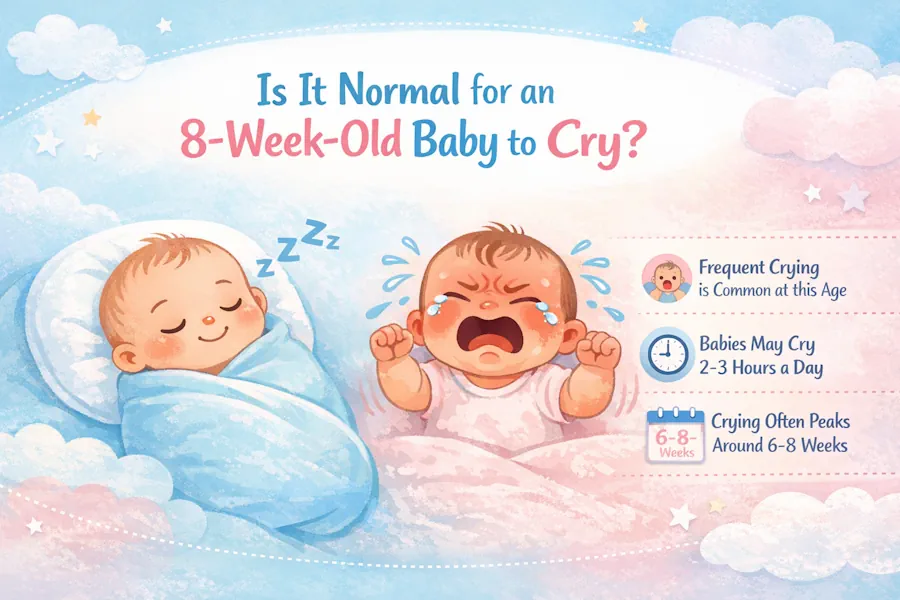
Crying in an 8-week-old baby is completely normal, and for many infants, this age can even represent a peak period of crying. Scientifically, between the sixth and eighth weeks of life, the baby’s nervous system is undergoing rapid development, which increases sensitivity to environmental stimuli. Crying at this stage is one of the primary ways babies communicate with those around them.
At eight weeks, babies are not yet able to regulate their emotions or soothe themselves. As a result, factors such as hunger, fatigue, the need for physical contact, loud noises, or environmental changes can trigger crying. Many of these crying episodes may seem to occur without a clear reason from a parent’s perspective, but from a neurological standpoint, they are a natural part of brain development.
Some babies experience longer periods of crying at this age, often more intense in the late afternoon or evening. This pattern can be mistaken for colic, although it does not always indicate illness or pain. If the baby is gaining weight appropriately, feeding regularly, and medical checkups are normal, increased crying alone is usually not a sign of a serious problem.
An important point is that crying in an 8-week-old baby is often temporary and gradually decreases as the nervous system matures. By around three to four months of age, many babies become calmer and better able to tolerate stimulation.
In general, crying in an 8-week-old baby is a normal part of development and is usually not a cause for concern. What matters is observing the overall pattern of behavior and consulting a doctor if symptoms such as severe irritability accompanied by fever, poor feeding, or lack of weight gain are present.
Feeding an 8-Week-Old Baby
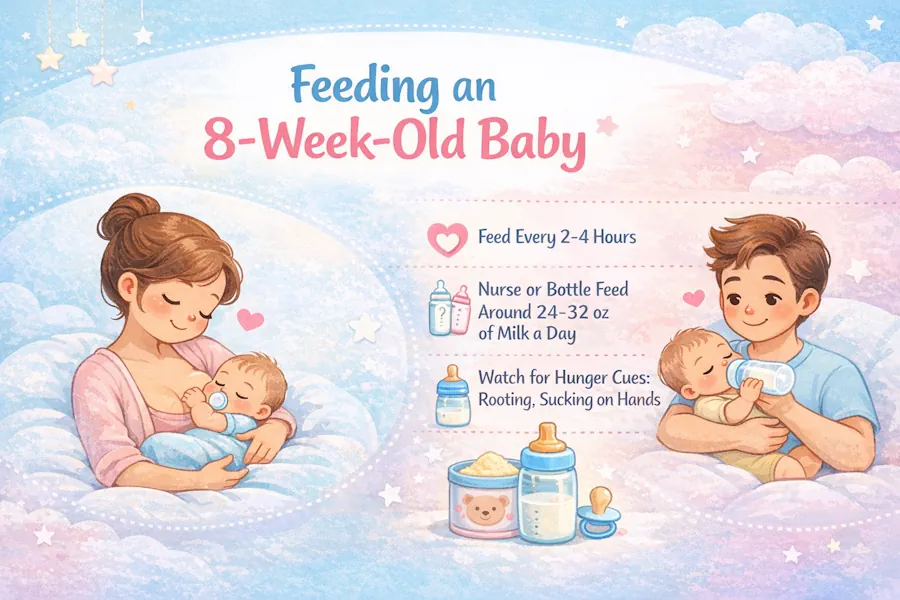
At eight weeks of age, a baby’s nutrition is still entirely based on milk, and the digestive system is not yet ready for solid foods or other liquids. Whether the baby is fed breast milk or formula, feeding patterns at this age are guided more by the baby’s needs than by a strict schedule.
An 8-week-old baby typically needs to feed every 2 to 3 hours, although the interval between feedings may be slightly shorter or longer in some infants. Increased feeding frequency on certain days is normal and is often associated with growth spurts. This behavior does not indicate that the milk supply is insufficient; rather, it reflects the baby’s increased energy needs for growth.
At this age, sucking becomes stronger and more coordinated compared to the early weeks. Many babies become calmer after feeding and may fall asleep. Signs such as regularly wet diapers, appropriate weight gain, and relative alertness during wakeful periods are the main indicators that feeding is adequate.
Babies who are breastfed may request feedings more frequently, as breast milk is digested more quickly. In contrast, babies who receive formula may sometimes go longer between feedings, but this difference alone does not indicate that one feeding method is superior to the other.
At eight weeks, mild reflux, small amounts of spit-up, or frequent burping can be normal, as long as the baby is growing well and does not show severe discomfort or unusual symptoms. If there is poor weight gain, severe vomiting, or refusal to feed, medical evaluation is necessary.
Overall, feeding an 8-week-old baby should be based on hunger cues rather than strict scheduling. Paying attention to signs of healthy growth is the most important way to assess whether nutrition is sufficient at this age.
Common Parental Concerns About an 8-Week-Old Baby
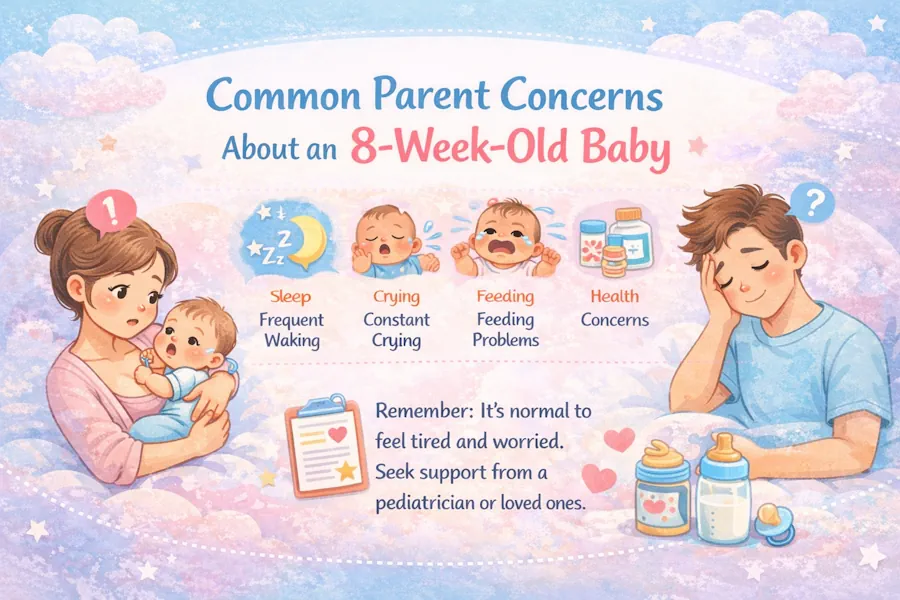
At eight weeks, many parents experience questions and concerns rooted in the baby’s rapid developmental changes. Differences between the baby’s behavior at this age and during the first weeks of life can cause uncertainty and anxiety, even though most of these changes are a normal part of development.
One common concern is irregular sleep. Parents may expect more structured nighttime sleep by two months, but scientifically, an 8-week-old baby has not yet reached this stage. Frequent nighttime awakenings, short sleep periods, and shifts between day and night sleep are normal at this age.
Excessive or prolonged crying is another frequent concern. Many parents worry about pain or illness, but at this age crying is often related to nervous system development, fatigue, or the need for contact. As long as the baby is feeding well, gaining weight, and showing no unusual symptoms, crying alone is usually not a sign of a serious issue.
Some parents are concerned about irregular arm and leg movements or brief tremors. These movements often result from an immature nervous system and typically decrease as the baby grows. A lack of full coordination at eight weeks is normal.
Concerns about how much the baby is feeding are also very common. Frequent feeding requests, prolonged sucking, or increased interest in feeding do not necessarily mean that the baby is not getting enough milk. Appropriate growth, wet diapers, and alertness are more reliable indicators of adequate nutrition.
Parents may also feel anxious when comparing their baby’s growth with that of other infants of the same age. It is important to remember that babies grow at different rates, and direct comparisons—especially at this age—can be misleading. What matters most is a consistent growth trend and medical guidance, not exact similarity to other babies.
Overall, most parental concerns about an 8-week-old baby are related to normal developmental changes. Medical consultation is necessary if symptoms such as fever, severe loss of appetite, weight loss, uncontrollable crying, or sudden behavioral changes occur.
Frequently Asked Questions About an 8-Week-Old Baby
Exactly how old is an 8-week-old baby in months?
An 8-week-old baby is approximately two months old. However, in medical assessments, age is often calculated in weeks at this stage because developmental changes occur very rapidly.
Is irregular sleep normal for an 8-week-old baby?
Yes. At eight weeks, regular nighttime sleep is not yet expected. Frequent awakenings, short sleep periods, and shifts between day and night sleep are normal.
How many hours should an 8-week-old baby sleep in a day?
On average, an 8-week-old baby sleeps about 14 to 17 hours per day, but this sleep is spread across multiple short periods.
What does excessive crying in an 8-week-old baby indicate?
In most cases, excessive crying at this age is related to nervous system development, fatigue, or the need for contact and is not a sign of illness. Crying accompanied by fever, poor feeding, or weight loss requires medical evaluation.
How often should an 8-week-old baby feed?
Most babies at this age need to feed every 2 to 3 hours. Increased feeding frequency on certain days is normal and often linked to growth spurts.
Is spitting up normal in an 8-week-old baby?
Small amounts of spit-up or mild reflux are common and usually normal, as long as the baby is gaining weight and is not unusually irritable.
What abilities does an 8-week-old baby have?
At this age, a baby may briefly hold their head up, respond to familiar sounds, make brief eye contact, and show more active arm and leg movements.
When should I take my 8-week-old baby to the doctor?
Medical attention is necessary if symptoms such as fever, refusal to feed, weight loss, uncontrollable crying, unusual sleepiness, or sudden changes in behavior are observed.
Final Summary
An 8-week-old baby is in one of the most sensitive and rapidly developing stages of early life. At this age, noticeable changes occur in brain development, the nervous system, body movements, sleep patterns, and the way the baby interacts with the surrounding environment. Many behaviors that may worry parents—such as irregular sleep, increased crying, or uncoordinated movements—are often normal parts of development.
At eight weeks, the baby still requires full care and support, and self-regulation abilities have not yet developed. Paying attention to signs of healthy growth, such as appropriate weight gain, effective feeding, and responsiveness to stimuli, is more important than comparing the baby with others. Differences in growth rates among infants are natural and should not cause early concern.
Ultimately, understanding the normal characteristics of an 8-week-old baby helps parents navigate this period with greater confidence and make informed decisions about caring for their child. If unusual symptoms or sudden behavioral changes occur, consulting a healthcare professional is the safest and most reliable course of action.







No comment